Breaking It Down: The Sermon on the Mount Week 10

By Jenna Walmer

 “Therefore I tell you, do not worry about your life, what you will eat or drink; or about your body, what you will wear. Is not life more than food, and the body more than clothes? Look at the birds of the air; they do not sow or reap or store away in barns, and yet your heavenly Father feeds them. Are you not much more valuable than they? Can any one of you by worrying add a single hour to your life? And why do you worry about clothes? See how the flowers of the field grow. They do not labor or spin. Yet I tell you that not even Solomon in all his splendor was dressed like one of these. If that is how God clothes the grass of the field, which is here today and tomorrow is thrown into the fire, will he not much more clothe you—you of little faith?  So do not worry, saying, ‘What shall we eat?’ or ‘What shall we drink?’ or ‘What shall we wear?’ For the pagans run after all these things, and your heavenly Father knows that you need them. But seek first his kingdom and his righteousness, and all these things will be given to you as well. Therefore do not worry about tomorrow, for tomorrow will worry about itself. Each day has enough trouble of its own.” –Matthew 6:25-34

It’s January. For high school a student that means the first round of finals are on the way. For college students, it means a new set of classes may be starting. Worried much? You shouldn’t be. Jesus says don’t worry about what is going to happen tomorrow! Just take each day at a time and roll along because… “each day has enough trouble.” Isn’t that so true! This is one of my favorite passages. Actually, any of the passages about worrying and trusting in the Lord are my favorite. It’s just a friendly reminder that you aren’t here alone. God’s got your back.

Worrying affects many aspects in life. It troubles our health and consumes our thoughts. Our productivity can be ruined from worrying. Also, our actions toward others can turn sour due to worrying. Lastly, and the worst of all, it can reduce our ability to trust God. Think about these attributes that are caused by worrying. How many of these are you currently experiencing?

The Message says, “Steep your life in God-reality, God-initiative, God-provisions. Don’t worry about missing out. You’ll find all your everyday human concerns will be met. Give your entire attention to what God is doing right now, and don’t get worked up about what may or may not happen tomorrow. God will help you deal with whatever hard things come up when the time comes.”

Trusting in God and turning to Him first is our panacea. If we worry about something, whether it is big or small, pray to Him about it. He is our comfort and our support. He will fill our thoughts will His desires instead of our petty desires.

When our thoughts are filled with Him, our planning for the future will be focused on Him as well. Trusting in God’s guidance instead of worrying about the plans will help us achieve His goals for us. People who worry about the future are filled with fear and have difficulty trusting Him. Don’t let the worries of tomorrow interfere with the plans of today.

Trust in the Lord with all your heart, soul, and mind. Let your trust in God alleviate your daily worries, the big ones and the small ones. Fulfill His dreams for you, worry free.


Jenna Walmer - Palmyra COB, Altantic Northeast DistrictJenna Walmer is from Lancaster County and is currently in 12th grade. In school, she loves to research historical events. If she were to live in a specific time period, she would want to be a hippie and live in the 60s or 70s. Her favorite past times are swimming and playing her trombone. If you want to know more about her random life, follow her on twitter: @jaymarie2100

Aussie Update: Common Grace Gives Prime Minister Solar Panels

Jarrod McKenna, who coined the term “Dunker Punks” is the national director of the new movement/organization Common Grace, a diverse group of Christians who are passionate about Jesus and Justice. Read this Common Grace press release to hear about they’re latest gift to Australian Prime Minister Tony Abbott and the Australian people!

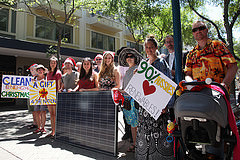
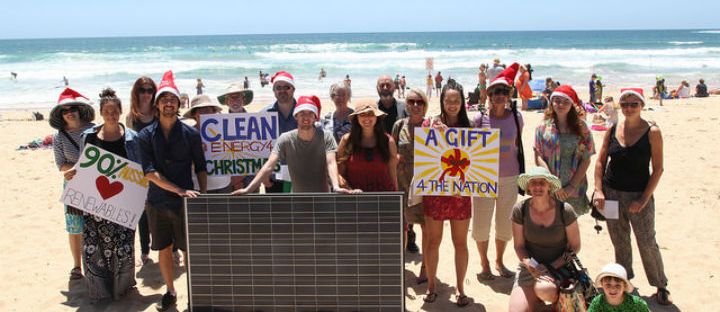
A diverse group of Christian leaders have delivered the gift of solar panels for Kirribilli House to Prime Minister Tony Abbott’s office in Manly this morning. The delegation of Christian leaders presented a letter of offer and a Christmas card to staff who committed to passing it on to the Prime Minister.

In just four days twelve solar panels were crowdfunded by Christians and everyday Australians to show suppcommon_grace_1ort for a strong Renewable Energy Target.

The crowdfunding initiative is led by Common Grace, a recently-launched and rapidly growing movement of thousands of Christians from various denominations who are passionate about Jesus and justice.

“The solar panels are a gift for the nation, from the nation, to symbolize public support for a clean energy future,” said Rev. Dr Michael Frost, vice principal of Morling College and Founder of Small Boat Big Sea.

“We know that 89% of Australians support a strong Renewable Energy Target. By giving solar panels to Kirribilli House, Christians are adding their voice to a chorus of Aussies who want to see a vibrant renewables industry. Our message to the Prime Minister is: don’t knock renewables until you’ve tried them,” said Rev. Dr Frost.

The Solar Council, the peak body for the solar industry in Australia, have contributed to the gift for Kirribilli House, offering to install the crowdfunded solar panels at no cost.

common_grace_2“As we all know solar panels need to be professionally installed. Therefore the Solar Council is adding to this gift. We will install the solar panels at Kirribilli House for free,” said John Grimes, CEO of the Solar Council.

The large-scale Renewable Energy Target seeks to deliver 41,000 GWH of Australia’s energy through renewable sources by 2020. Meanwhile, figures recently released by the Australian Bureau of Statistics show that 1 in 5 Australian households are now using solar.

Jacqui Remond, Director of Catholic Earthcare Australia, was on hand to deliver the solar gift this morning. “As Christians, we recognize that the earth is a gift and I want to pass on a clean energy future to our children and grandchildren,” she said.

“Climate change isn’t just an environmental issue – it’s a matter of justice. It’s about people in poverty, particularly indigenous populations, who are being hit first and hardest for what they’ve contributed to least. It’s also about Australians who are preparing to face more intense and frequent bushfires as we approach what could be the hottest summer on record,” she said.

Jody Lightfoot is the Climate Justice Campaigner at Common Grace. “We’ve just launched Commocommon_grace_3n Grace and we’re learning what it looks like to live out the beauty, generosity and justice we see in Jesus as the earth heats up at an unprecedented rate. We’re learning what it means to love our neighbors who are at the front lines of climate change and how we can be stewards of the earth in the face of our ecological crisis,” he said.

The Christian leaders who are delivering the solar panels this morning include: Jacqui Remond, Director of Catholic Earthcare Australia; Rev. David Fell, Youth Minister, St Matthew’s Anglican; Rev. Karl Hand, Crave Metropolitan Community Church; Weis Schiuringa, Quakers NSW; Jody Lightfoot, Climate Justice Coordinator, Common Grace

The solar gift initiative is also supported by other local church leaders including Rev. John Buchanan, St Peter’s Presbyterian Church; Rev. Dr Michael Frost, Vice Principal, Morling College and Founder of Small Boat Big Sea; Rev. David Gore, Uniting Church Minister, Manly Village Congregation.

If the Prime Minister and the independent trust that looks after Kirribilli House do not accept our Christmas gift, we will offer the solar panels to the Davidson Brigade of the Rural Fire Service, of which Mr Abbott is a long time member. Fire fighters are on the front line of climate change fighting increasingly frequent and intense bushfires. It’d be a small way we can say thank you for what they do.

Breaking it Down: The Sermon on the Mount Week 9

By Jenna Walmer

“When you fast, do not look somber as the hypocrites do, for they disfigure their faces to show others they are fasting. Truly I tell you, they have received their reward in full. But when you fast, put oil on your head and wash your face, so that it will not be obvious to others that you are fasting, but only to your Father, who is unseen; and your Father, who sees what is done in secret, will reward you. Do not store up for yourselves treasures on earth, where moths and vermin destroy, and where thieves break in and steal. But store up for yourselves treasures in heaven, where moths and vermin do not destroy, and where thieves do not break in and steal. For where your treasure is, there your heart will be also. The eye is the lamp of the body. If your eyes are healthy, your whole body will be full of light. But if your eyes are unhealthy, your whole body will be full of darkness. If then the light within you is darkness, how great is that darkness! No one can serve two masters. Either you will hate the one and love the other, or you will be devoted to the one and despise the other. You cannot serve both God and money.” – Matthew 6:16-24

All around us there are signs of materialism: the newest trends of phones, clothes, makeup, and other hot items that people fall for the trap of conformity. People look forward to the newest version of phones and upgrade early so they can be the “cool kid” on the block. They change their style so they can “fit in.” But really, are they “fitting in” to God’s kingdom?

In Jesus’ Sermon on the Mount, he explains how earthly treasures destroy us. “Moth and vermin” can destroy the items and “thieves” can break in and steal it. There are so many consequences to building up a great pile of “stuff” on earth that, in reality, is temporary and vanishes once God takes our lives and we are no longer on earth.

He suggests an alternate path to take instead of purchasing a lot of “stuff” and having many earthly treasures that hurt your relationship with God. He wants us to seek eternal values and “store our treasures in heaven.” If money and possessions become too important to us, we must reestablish control over this out of control behavior and get rid of the items that are inhibiting our relationship with God.

So how do we store up our treasures in heaven? It is not limited to just tithing! It can be accomplished by doing good deeds to those in need and being obedient to God. We must seek fulfillment of God’s intentions of our lives. It is our job to live on earth to fulfill his purpose for us, because we have a “predestined plan” that he created, and he wants to see us complete it (Ephesians 1). So, to build up our treasures, seek out your plan and go for it, no matter how far out it may seem.

If we continue to build on earthly possessions, our sight for our plan will be clouded; we will only be able to see what WE want to do for ourselves. However, if we serve God in our best capacity, our vision will be restored and our spiritual vision will give us the sight to see what God wants us to do—we will have a “healthy” eye that is fixed on God and can continue to fulfill is plan for us.

Also, this portion addresses “the master.” We live in a materialistic society. But, we want to live for God. If we spend our whole life collecting and storing “stuff” that will only be left behind once we die, what good in God’s eyes did our life do? Did we fulfill his purpose?

Our main priority, and one master, should be to what doesn’t fade, what cannot be stolen, and what cannot be destroyed by moths and vermin. We should store our treasures in heaven, focus on Him, serve Him to our fullest potential, and go after His purpose. Let go of the earthly possessions because they are fog in front of you skewing your bright future. Look to God for everything because He leads us on the right path.


Jenna Walmer - Palmyra COB, Altantic Northeast DistrictJenna Walmer is from Lancaster County and is currently in 12th grade. In school, she loves to research historical events. If she were to live in a specific time period, she would want to be a hippie and live in the 60s or 70s. Her favorite past times are swimming and playing her trombone. If you want to know more about her random life, follow her on twitter: @jaymarie2100

Want to contribute? Fill out a Dunker Punks profile, and/or email dunkerpunks2014@gmail.com.

Ebola Fighters Provide an Important Alternate Definition of Heroism

Like many in the Church of the Brethren, I was pulling for the kidnapped Nigerian girls to be named Time’s Person of the Year. If you don’t know, many of those girls are members of the EYN, the Church of the Brethren in Nigeria. The EYN has been particularly devastated by the terrorist organization Boko Haram, which operates in Northern Nigeria. To learn more about what Dunker Punks are doing for those girls and the EYN, and how you can get involved, you can click here. Even though they didn’t win, just the fact that they were in the running means people are still hearing about them and learning about what’s going on in Nigeria, so I’m thankful that they were at least considered.

However, one of my next top choices was the Ebola Fighters, and I am beyond thrilled that they were named Time’s 2014 Person of the Year. My reason is simple: I think there are few people who are more heroic than the Ebola Fighters. My other top choice, by the way, was Malala Yousafzai, another example of true heroism.

Christians in the United States live in fear. We’re afraid of a lot things. We’re afraid of terrorism. We’re afraid of people who don’t look like us, speak like us, or practice the same religion as us. We’re afraid of the boogey man. We’re afraid of our shadow. We’re afraid of being struck by lightening, while being attacked by a clown, who is riding a great white shark, who is wishing us “Happy Holidays” instead of “Merry Christmas.” We’re a timid bunch.

But more than anything, in 2014 we were afraid of Ebola. Ebola was everywhere. In our streets, in our schools, in our water, in our churches, in our homes. Hide your kids, hide your wives, hide your husbands, because everybody was getting Ebola in 2014.

If you can’t tell, I’m being sarcastic. To be clear, I am glad that we took the threat of Ebola seriously in the United States. The worst thing that we could have done would have been to not take proper precautions against the spread of Ebola. And even though we only had four cases of Ebola in the United States and one death, even one death is a tragedy and should be viewed as such. However, there is a huge difference between taking something seriously and being absolutely terrified of something. To the point that living in fear takes Ebola less seriously than dealing with it calmly and courageously.

The problem with living in fear of Ebola in the United States is that Ebola is a gravely serious and deeply tragic issue in other parts of the world. It is a genuine threat, not a manicured threat like it was here. There are countries in Africa that have been crippled by Ebola, and continue to face grave projections for the coming months. These countries do not have the resources, technology, personnel, or medical infrastructure needed to effectively deal with Ebola like the United States did. In the three most affected countries, there have been nearly 12,000 deaths and over 18,000 cases of Ebola, and some projections have indicated that hundreds of thousands or even millions may eventually be affected.

Living in fear of Ebola in the United States draws crucial attention away from countries like Sierra Leone, Liberia, and Guinea that badly need the help of the international community, especially the United States. If we choose to worry irrationally, unnecessarily, and excessively about our own safety, we will be less willing to do what it takes to provide for their safety.

How do I know? Because a legitimately considered response to Ebola, supported by many influential people in the United States, was to restrict all travel between the affected countries and the United States. Many people who feared Ebola thought the proper response was to shut out those who so badly needed our help. Additionally, now that Ebola is no longer a threat to the United States, we hear less and less about it each day, though it continues to ravage parts of Africa.

When we make things about ourselves, people suffer. When we live in fear, we turn a blind eye to those who are in great need. And Christians in the United States are at least as guilty of this as the rest of the country, thought I suspect we are far more guilty.

That’s why the Ebola Fighters are heroes. They saw a terrible disease, and instead of fearing it, they chose to do something about it. Instead of making it about themselves, they made it about the people who actually needed help. They left their homes, families, and livelihoods to do what was right. They risked their lives to heal people. And I shouldn’t put this in the past tense. They continue to do these things.

Not all of the Ebola Fighters are Christians, I’m sure. But they all model Christ better than we Christians in the United States do. Jesus showed us how we are to lead. He was unafraid yet gentle. He didn’t compromise his values, yet he treated others with love, dignity, and respect. He didn’t consider his safety or social conventions when he brought others healing. He didn’t give people what they deserved, but what they needed. He had the courage to speak out against power and speak up for the powerless. He brought a message of hope, not fear. He was willing to die to bring life to everyone, but he was not willing to kill anyone.

Christians need to observe a new definition of heroism modeled after Christ, not empire. If it is “heroic” to pick up a gun and risk your life to fight for your country, how much more heroic is it to put down that gun and risk your life to heal others? If it is “courageous” to stand your ground as a police officer against an unarmed black teenager, how much more courageous is it to stand your ground as a young Pakistani girl against the Taliban for your right to an education? If it takes “leadership” to make the tough decision to use torture, how much more leadership does it take to make the right decision not to use torture?

Paul wrote to Timothy, “God did not give us a spirit of cowardice, but rather a spirit of power and of love and of self-discipline.” In Christ, we have tremendous power. It is the power to heal, not to kill. It is the power to create, not to destroy. It is the power to love, not to hate. It is the power to build God’s kingdom, not Earth’s empires.

The Ebola Fighters fill me with tremendous hope for the world. It is the same hope found in Christ. When I see headlines that read “Ebola in America” I see a society that has lost the imagination it takes to live outside of fear. But when I see a group of doctors willing to risk everything to save the lives of people they’ve never met in a country they never thought they’d visit, I catch a glimpse of the Kingdom.

Everyday, as I learn more about the EYN and their tremendous courage and leadership in Nigeria, I have an example of who I must strive to be as a Christian. Sadly, Christians in the United States have lost sight of what the word Christian means. We worship a version of Jesus who would be unrecognizable to the twelve disciples.

I hope we take a lesson from the Ebola Fighters. I hope we stop living in fear. I hope we stop succumbing to fear by choosing hatred and violence, but choose instead to overcome fear with hope and compassion.

Dunker Punks, let’s be leaders. Let’s be courageous. Let’s fight diseases, and poverty, and hunger, and racism, not wars. Let’s learn from the Ebola Fighters. Let’s show the world what Jesus really looks like.


Emmett Eldred - Hollidaysburg COB, Middle PA DistrictEmmett Eldred is a sophomore Creative Writing; Professional Writing; and Ethics, History, and Public Policy Major at Carnegie Mellon University. His passions include reading about, writing about, and snuggling with pugs. Emmett is the founder of DunkerPunks.com, and he wants lots more people to contribute! Fill out a Dunker Punks profile, and join the conversation! Follow Emmett on twitter @emmetteldred and follow Dunker Punks on Twitter @DunkerPunks and on Facebook. Want to contribute? Fill out a Dunker Punks profile, and/or email dunkerpunks2014@gmail.com.

Breaking it Down: The Sermon on the Mount Week 8

By Jenna Walmer

“And when you pray, do not be like the hypocrites, for they love to pray standing in the synagogues and on the street corners to be seen by others. Truly I tell you, they have received their reward in full. But when you pray, go into your room, close the door and pray to your Father, who is unseen. Then your Father, who sees what is done in secret, will reward you. And when you pray, do not keep on babbling like pagans, for they think they will be heard because of their many words.  Do not be like them, for your Father knows what you need before you ask him. 

“This, then, is how you should pray: “‘Our Father in heaven, hallowed be your name, your kingdom come, your will be done, on earth as it is in heaven. Give us today our daily bread. And forgive us our debt, as we also have forgiven our debtors. And lead us not into temptation, but deliver us from the evil on. For if you forgive other people when they sin against you, your heavenly Father will also forgive you.  But if you do not forgive others their sins, your Father will not forgive your sins.” – Matthew 6:5-15

It has been almost five months now since NYC. Have you been living up to the challenge of saying the Lord’s Prayer every day? I know I do not say it every single day, but it’s become almost routine. However, it is important that this unique prayer Jesus gave us in the Sermon on the Mount doesn’t lose its meaning. My youth group began writing our own Lord’s Prayer and we have also looked into other versions of the Lord’s Prayer. As the original version may become monotonous to you, try researching new versions of the prayer, in other languages, in other versions of the Bible, or write your own to see what the Lord’s Prayer means to you.

Prayer is more than just reciting one single prayer daily, or multiple times a day. It’s having a conversation with our Heavenly Father about our fears, about our thanksgivings, and about whatever you really want to say.

The Lord’s Prayer was given to us to use as a model for prayer. When we pray, we should remember to pray to praise God, for his work in the world, for our needs, and for our help with struggles. In your daily prayers, do you incorporate all of these parts that Jesus provides? Which one do you use this most?

The Lord’s Prayer can be broken down even further to understand individual parts of it. This is handy to develop your own version and to understand praying more thoroughly. Throughout the prayer, Jesus indicates that God is holy, yet personal and loving. He then notes that His “kingdom” refers to his spiritual reign. By asking that his will be done, we are praying for God’s purpose to be accomplished in this world. We then acknowledge that God is our provider. He also leads us away from our tempters and helps us forgive others. This prayer is the formula that helps Christians live a life with God as their center.

Jesus also tells us not to draw attention by our prayers. When praying publically, make sure your prayers are heartfelt and focus on addressing God. Before praying, either publically or privately, make sure your intentions are pure and you mean what you say to the Lord. As we pray remember to keep sincerity in mind and your thoughts clear.

So in the upcoming weeks, look into the Lord’s Prayer and write yours down own. Make sure your public prayer is sincere, and not for show. Pray for those who persecute you and for God’s will to be done in this world. May the power of prayer help you live your Dunker Punk lives.


Jenna Walmer - Palmyra COB, Altantic Northeast DistrictJenna Walmer is from Lancaster County and is currently in 12th grade. In school, she loves to research historical events. If she were to live in a specific time period, she would want to be a hippie and live in the 60s or 70s. Her favorite past times are swimming and playing her trombone. If you want to know more about her random life, follow her on twitter: @jaymarie2100

Want to contribute? Fill out a Dunker Punks profile, and/or email dunkerpunks2014@gmail.com.

One Dunker Punk’s Thoughts On Protest

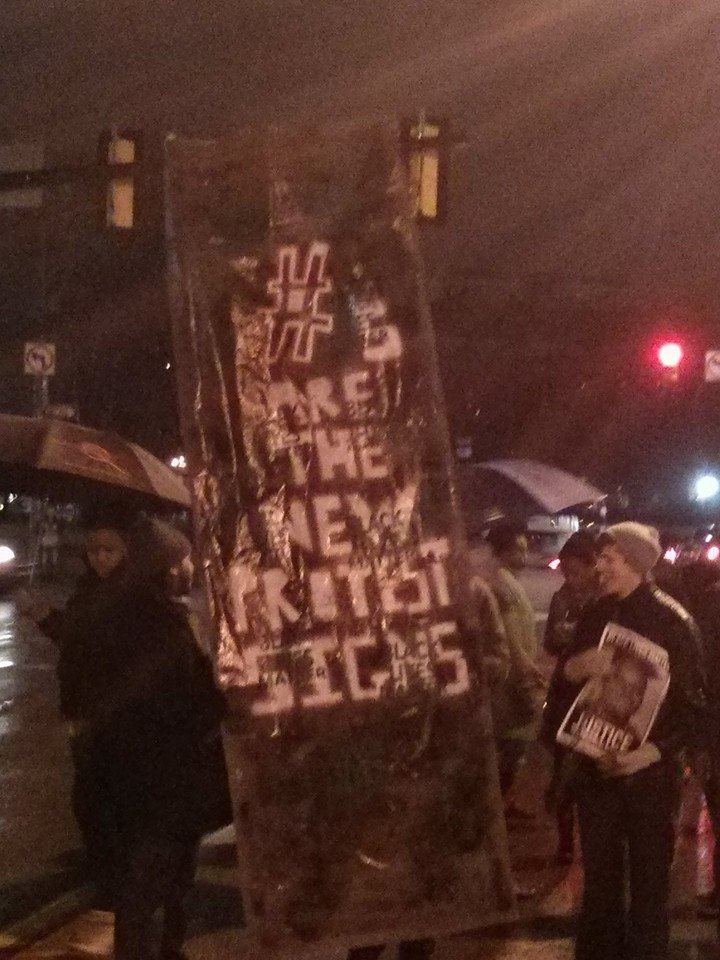
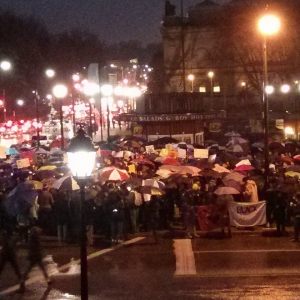
Last night, a crowd of 300-500 nonviolent protesters gathered in the cold rain in the Oakland neighborhood of Pittsburgh, to peacefully voice their anger, anguish, and fear after several recent high profile instances of police killing uprotest7narmed black men. The protest was organized by several Pittsburgh high school students, and it was attended by mostly high school and college students, with some adults. It was one of dozens of #ShutItDown protests taking place across the country: peaceful protesters gathering, rallying, and then marching down the street. I was one of the protesters, and I wanted to share my experiences and thoughts with all my Dunker Punks friends.

First, here’s how things went down for me:

I arrived at approximately 5:05 PM, about 5 minutes after the protest was scheduled to begin. The protest took place in a public area called Schenley Plaza. The people were packed around a series of speakers using a megaphone. By the time I got there, the crowd was too large to even see the people speaking, so I circled the crowd taking pictures.

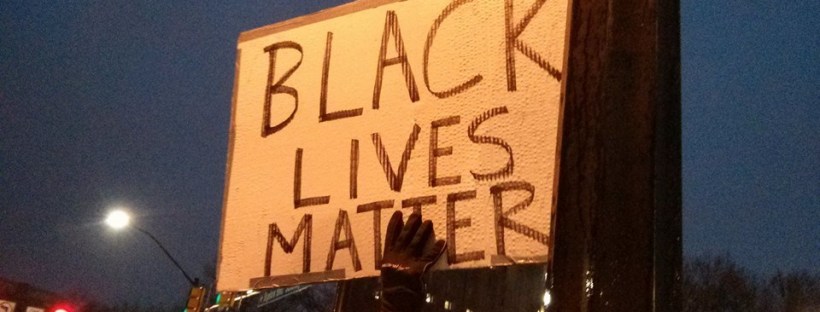
At around 5:45, we began theprotest3 “Shut It Down” part of the protest. We made a loop around two city blocks, marching on the two major streets in this area of Pittsburgh, and chanting phrases like “Hands Up, Don’t Shoot” and “Black Lives Matter.” This took all of about 15 minutes, but it sent a powerful message, and onlookers joined the crowd as we continued to march.

When we returned to Schenley Plaza, we made a circle in the intersection. The organizers stood in the middle of the circle, and led us in a few chants. After the organizers left the circle, the protesters joined in an impromptu “die in,” where they laid on the ground for a few minutes in the intersection. The organizers came back, and asked the crowd to peacefully disperse. We had made our point, and it was time to be cooperative and respectful, especially since the people of Pittsburgh and the police had been cooperative and respectful to us.

At this point, I left, which leads me to my thoughts: 

First of all, this was an entirely student led protest. It was organized by a group of high school students. They saw something wrong with the world, and they decided to do something about it. That’s Dunker Punk level leadership, and it’s also a Dunker Punks challenge. If you think you’re too young to make a difference or take leadership, look at all the amazing young people across the world who are doing just that.

I also want to make it clear that the Pittsburgh Police were exemplary in this protest, protest13and they deserve a lot of credit for the actions they took. Though the police responded to the situation, they did so in a calm, measured, and respectful way. It became immediately clear to me that they were concerned with protecting our safety and our right to protest, rather than with clearing the protest so that the city could return to its business. The police cleared the streets and stopped traffic so that we wouldn’t be in danger of oncoming cars.

These protests are not to say that all police are bad. We know that all police aren’t bad, and everyone at this protest saw it first hand. These protests are to say that there are bad police who use bad tactics, tactics that are far too forceful, and tactics that have very clear racial bias to them. These protests are to say that there is a system in place that protects the bad police, rather than encouraging all police to be like the good ones. These protests are to say that the system acts as if black lives do not matter. These protests are to say that there are people in this country who feel afraid and demonized by the people who are supposed to protect and serve them. These protests are to say that the black community is deeply hurting at the loss of its loved ones. And that’s why I joined the protest. I’ve never felt afraid or untrusting of the police. I’ve never been hurt by the police. And I think everyone deserves to live in a world where they can feel that way. If I was a good police officer, I would feel outraged at the bad police officers who are tarnishing my efforts and commitment to protect people and make them feel safe.

And that takes me to some of the negatives that I saw in the protest:

First: the crowd was very exprotest12cited, and it was getting a lot of positive energy from the people speaking. Until this one guy took the megaphone. Whereas every other speaker was a black man or woman (they were mostly women), this guy was a white man. That isn’t necessarily a bad thing (I’ll get to that in a moment), but his message was bad. He took this opportunity in front of hundreds of people to promote his own political organization. He talked at length about what his organization does and when and where they meet. You could feel the crowd deflating. In terms of energy, it was the low point of the night.
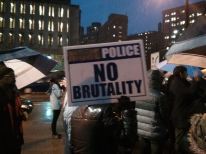
Second: There are chants that I think are productive, and there are chants that I think are counterintuitive. I like chants like “Hands Up, Don’t Shoot” and “I Can’t Breath” and “Black Lives Matter” and “Shut It Down.” These chants are all peaceful and nonviolent. They call attention to injustice, while elevating the conversation to a higher standard. I don’t like chants like “No Justice, No Peace” or chants about individual racist police officers or chants that use profanity. These chants still highlight the injustice, but they make it hard for the protesters to separate themselves from the injustice that they are protesting.

Saprotest8ying “no justice, no peace” is to say, “I have been treated wrongly, so I will respond with wrongdoing.” It’s a promise, or at least an invitation, to violence. And it’s not what is needed. Talking about individual racist police officers makes the conversation about vindication and vengeance, rather than about seeking to dissolve injustice. There is absolutely a big racial bias in our justice system, and the presence of racism needs to be addressed. But making it about individual racist police diminishes the problem and represents only a narrow conception of justice. I’m not offended when I hear profanity, but using profanity allows critics of these protests to make it about the language that the protesters are using, rather than the change they are seeking. Don’t give critics that ammo. Use language that is becoming of the change you wish to enact.

Nonviolent protest is effective because it draws a contrast between the victims and the perpetrators. It highlights the depravity of violence and injustice. It showcases the suffering caused by oppression. If your protest against injustice comes with the promise of acts of violence, or even the suggestion that that is acceptable, you are defeating yourself.

Finally, the protest continued after I left. I’m not against a long-winded protest, but I do think it was wrong in this case to continue, only because the organizers of the protest had asked the crowd to disperse or at least return to the sidewalk. As I was walking away, I turned around to see the protesters again heading down the street, except this time it was a much smaller, much whiter crowd. It’s easy to get caught up in the excitement of a protest, and that’s ok, but I do think protests should remain respectful to their organizers. The students who marched down the street a second time effectively demonstrated that they did not respect the leadership of the organizers. They hijacked the protest for their own reasons. But I want to be clear that my objection to this second protest was not because of the disruption it caused to traffic, but because it was outside the scope and leadership of the protest, and I’ll explain why shortly.

This brings me to my last section, tips for Dunker Punks if you want to join a protest: 

Tip #1: Listen to the organizers, and respect their leadership. Chances are, your protest will be organized by black men and women, and chances are, if you’re a Dunker Punk, you are probably white. Not all Dunker Punks are white. We’re a diverse group, but in general the Churcprotest17h of the Brethren in the United States is a very white denomination. This is something we should fix, but it’s also just a true statement for the purposes of this article.
If you’re white, you’re more than welcome to get involved and protest. I’m white. It’s important that Dunker Punks care about these issues. But if you’re white, you have to take extra care to take a supportive and not leading role in protests like these that have racial motivations. It’s great that you want to get involved and make a difference, but if you become so dominant that you are usurping control of the situation, you are in effect reinforcing the influence of white supremacy in our society. White people aren’t supreme, but they have been raised in an environment that encourages them to take control of situations and be leaders. In this case, take care to be a follower, and if you see other white people doing this, say something to them. They probably don’t realize that their good intentions are being expressed in the wrong way. Remember that I said that the second protest was predominantly white, whereas the first was predominantly black. And remember that white guy who took the megaphone and promoted his own organization and cause. If you’re white, support, be empathetic, take leadership when it is appropriate, but don’t usurp leadership from black organizers.

Additionally, listening to the organizers is the best way to ensure that the protest stays under control. If the protest gets out of control, that when it can get violent or destructive.

protest4Tip #2: Research the protest beforehand. As Dunker Punks, we should feel compelled to make a difference in the things that matter to us, but we must also be sure that we are using the proper, Christlike channels. Our motivation is not simply to seek out change, but to seek out change that looks like Jesus, in ways that look like Jesus. Please research to make sure the organizers of your protest are clear about keeping this nonviolent. In my case, the organizers were clear in inviting others to the protest that it was strictly nonviolent, and no violence would be tolerated.

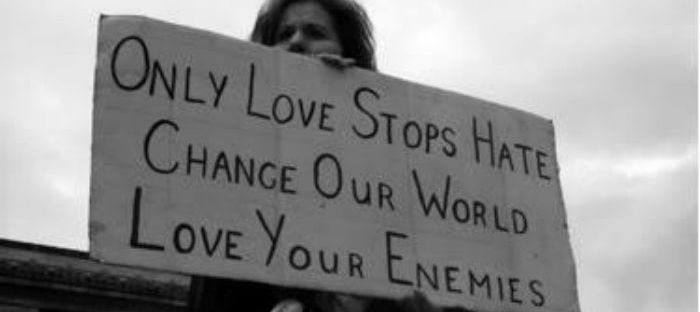
Tip #3: Look like Jesus at the protest. If your protest is large enough, there will be people who believe in using violent measures to get what they want. There are always extremists. But we aren’t extremists, we’re radicals. And as radical Christians, we must look at the roots of our faith, where we see Jesus, who very clearly condemns violence, especially in response to injustice. Follow Jesus at your protests, don’t chant “No Justice, No Peace.” More importantly, don’t believe it. Don’t incite violence, and stop violence if you see it happening. Be peaceful, be nonviolent, but never keep your eye off the goal of stopping injustice. That’s how we enact cross-shaped change.

How are you making the world look more like Jesus? Use #DunkerPunksCare, or fill out a Dunker Punks profile!

Emmett Eldred - Hollidaysburg COB, Middle PA DistrictEmmett Eldred is a sophomore Creative Writing; Professional Writing; and Ethics, History, and Public Policy Major at Carnegie Mellon University. His passions include reading about, writing about, and snuggling with pugs. Emmett is the founder of DunkerPunks.com, and he wants lots more people to contribute! Fill out a Dunker Punks profile, and join the conversation! Follow Emmett on twitter @emmetteldred and follow Dunker Punks on Twitter @DunkerPunks and on Facebook.

Breaking it Down: The Sermon on the Mount Week 7

By Jenna Walmer

“Be careful not to practice your righteousness in front of others to be seen by them. If you do, you will have no reward from your Father in heaven. So when you give to the needy, do not announce it with trumpets, as the hypocrites do in the synagogues and on the streets, to be honored by others. Truly I tell you, they have received their reward in full. But when you give to the needy, do not let your left hand know what your right hand is doing, so that your giving may be in secret. Then your Father, who sees what is done in secret, will reward you.” – Week 7: Matthew 6: 1-4

How appropriate. The section for the week is about giving is on the week of ThanksGIVING and Giving Tuesday. In my preacher’s sermon this past Sunday, he emphasized on how being thankful and showing your gratitude to people can affect the homes, workplace, and relationships. During every Thanksgiving season, we are challenged to be more thankful and to spread this attitude. However, this passage challenges us to give as well and presents a way to give with gracious hearts.

Jesus reminds us to “perform” our duties for the Lord and the Lord only, because when doing actions for the wrong reason, the Lord will not reward you. Providing an example, Jesus explains that you should not go boasting your good deeds because that is not righteous. If you do, you are considered just as holy as the “hypocrites”- the people who do good deeds with poor motives. The only prize they receive is their fame.

However, as always, Jesus offers an alternative. When Jesus says, “Do not let your left hand know what your right hand is doing,” he is symbolically teaching that it is easy to give with mixed motives; however, you should give with a pure heart and do so that you do not expect to get something in return. Believers are responsible for giving just for the pleasure of giving in return for God’s love.

Do you give because of how you appear to other, or do you give because it makes you feel good?

Before you do another kind gesture, ask yourself, “Would I still do this if nobody found out about it?”

It may be easier to be generous for the eyes of others and recognition, but that does not reflect our God-centered lifestyle. Give to make God look good, not yourself. Give to make others happy, and in return, you will be filled with joy. Give to be glorified by the Lord.

During the holiday season, remember to pray for those who are being persecuted for their faith. Our brothers and sisters are still being mistreated, and they are in dire need of our assistance. Consider giving to the Nigeria Crisis Fund and continue praying for peace in the conflicted areas.

Also, during the Thanksgiving and Christmas season, give thanks to all who contribute to your life and give happiness to those in need, in whatever creative way that brings joy to the Lord and to the other people. But just remember to ask yourself, are you doing it for fame or pleasure of giving?


Jenna Walmer - Palmyra COB, Altantic Northeast DistrictJenna Walmer is from Lancaster County and is currently in 12th grade. In school, she loves to research historical events. If she were to live in a specific time period, she would want to be a hippie and live in the 60s or 70s. Her favorite past times are swimming and playing her trombone. If you want to know more about her random life, follow her on twitter: @jaymarie2100

Want to contribute? Fill out a Dunker Punks profile, and/or email dunkerpunks2014@gmail.com.

Dunker Punks During the Christmas Season: “Go Big” in a Different Way

As Black Friday kicks off the Christmas shopping season, remember that we Dunker Punks are a peculiar people. We’ve set ourselves apart to live lives committed to following Jesus. We are in the world, doing good works, creating justice, building peace, but we are not of the world. Here’s some thoughts to consider from Brethren economist Bill Wood:

One of the big-box retailers invites us to “Go Big!” this Christmas. That retailer wants us to buy big-screen TVs, which will bring in programming and ads to keep us going big and coming back to the store in the new year.

But after seeing the ad, I started thinking. What if we Dunker Punks (and stealth Dunker Punks) decided to “Go Big!” this Christmas in a different way? This would include things such as:

  • Going big in our food drives, sending off carloads of food to the food banks and food pantries
  • Going big in our Bible study, seeking out the Old Testament prophecies and New Testament gospel accounts to deepen our understanding of Christ’s first advent
  • Going big in our humility, not proclaiming our good works but taking quiet joy in the honor that it is to help and pray for our fellow men and women, inside the church family and out

Yes, at times it would mean visiting stores that tell us to Go Big! – but with a glad heart rather than an aggressive desire to beat somebody else to that great special on Black Friday. And it would mean special smiles and kind words for everyone we met along the way, from the Salvation Army volunteer by the red kettle to the harried checkout clerk facing a long line of customers.

How about it, Dunker Punks – are you up to Go Big! this Christmas?

COB Youth Start Dunker Punks Cafe

It’s Sunday morning. You’ve indulged in the snooze button one too many times. You’re running late for church, and now you have two options. Option 1: skip your coffee run and risk falling asleep during the morning prayer. Option 2: stop for coffee, show up late, and take the walk of shame to the only open seats, which are of course in the front row.

That is, unless you go to Beacon Heights Church of the Brethren in Ft. Wayne, IN.

The Dunker Punks at Beacon Heights have started a “Dunker Punks Cafe,” to serve church members free coffee before Sunday school. It’s a simple operation, just coffee and a few other hot beverages served from a window between the church kitchen and fellowship hall. But like the best things Dunker Punk, it’s a small act that’s going a long way.

The other day, I spoke with Beacon Heights youth leader Megan Sutton and learned more about the Dunker Punks Cafe. I was excited and amazed to hear about the impact that this ministry is already having in the congregation and in the local community. But perhaps the biggest impact is on the Dunker Punks themselves.

The impact that this ministry has within the church is pretty straightforward. “It’s a way for our youth to connect with the congregation,” Megan said. The Dunker Punks at Beacon Heights know that the best way to connect with others is to serve them. That’s what Jesus always did.

Service at the cafe is completely free, but congregation members are encouraged to give a freewill donation. Every few months, the Dunker Punks will take the donations that they’ve collected and give them to a local charity organization. Even selecting which charities to give to is a chance for the Beacon Heights Dunker Punks to grow as followers of Jesus. According to Megan, they take the time to research every charity that they consider, trying to find links between the service that that organization provides and Jesus’ teachings.

This process isn’t just to find the best use of the Dunker Punks’ hard earned money. It’s also a chance for them to find other opportunities to go out and serve the community. After they’ve found a charity that they like, the Dunker Punks at Beacon Heights are encouraged to volunteer.

Though the Dunker Punks Cafe was only launched in September, it’s already been a huge success. Megan has been especially happy at how every member of the Beacon Heights youth group has been able to find their own niche in the project. “Our youth group is pretty small, but we have a very diverse group in terms of age.” Megan told me, “We wanted to find a project that youth of various ages and maturity levels could come together and enjoy.”

For that to happen, Megan said that they needed to think outside the box. “Before NYC, we already knew that we wanted to make a change, but we were thinking something along the lines of a new curriculum or resources or teacher. Inside the box thinking.” After NYC and the beginning of the Dunker Punks movement, the Beacon Heights youth began to realize that they needed an active, service oriented ministry. They returned from NYC jazzed up, excited, and ready to think outside the box.

“NYC provided a lot of fuel,” said Megan. She worked with her youth to develop the idea for the Dunker Punks Cafe, and she continues to provide support, but it is their ministry. “They run it. They have taken off with it,” she said. They are learning as they go. Not just about running a successful ministry, but about following Jesus and putting his teachings into practice by serving like Jesus.

Putting the Dunk In Dunker Punk

Putting the Dunk In Dunker Punk

I asked Megan how she thinks this project relates to the Dunker Punks movement. It “equips them to be leaders.” she said, “Rather than just talking about making a difference, they are going out and actually doing it.”

A big part of the Dunker Punks movement is about youth discovering that they can make an impact. Megan believes that her youth are learning exactly that. She said she wants the Beacon Heights Dunker Punks to reflect on the impact that they’re having and wonder, “What can they do when they are older and have more resources?” Then, she corrected herself, “In fact, what broader impact can they have right now? They are experiencing that they can do it.”

The theme of NYC was “Called by Christ, Blessed for the Journey Together.” This goes back to what Megan said about each of the Beacon Heights Dunker Punks finding a niche in the project. She said that they are all “finding and exploring a calling.” Each is taking action and doing something that they enjoy, all while serving the congregation and community. If they haven’t found the part of the project that they enjoy yet, they will. They’ll think outside of the box. They’ll get creative. They’ll get radical. It’s what Dunker Punks do. “It’s really cool to watch,” said Megan.


EmmeEmmett Eldred - Hollidaysburg COB, Middle PA Districttt Eldred is a sophomore Creative Writing; Professional Writing; and Ethics, History, and Public Policy Major at Carnegie Mellon University. His passions include reading about, writing about, and snuggling with pugs. Emmett is the founder of DunkerPunks.com, and he wants lots more people to contribute! Fill out a Dunker Punks profile, and join the conversation! Follow Emmett on twitter @emmetteldred and follow Dunker Punks on Twitter @DunkerPunks and on Facebook.

Breaking it Down: The Sermon on the Mount Part 6

By Jenna Walmer

“You have heard that it was said, ‘Eye for eye, and tooth for tooth.’ But I tell you, do not resist an evil person. If anyone slaps you on the right cheek, turn to them the other cheek also. And if anyone wants to sue you and take your shirt, hand over your coat as well. If anyone forces you to go one mile, go with them two miles.  Give to the one who asks you, and do not turn away from the one who wants to borrow from you. “You have heard that it was said, ‘Love your neighbor and hate your enemy.’ But I tell you, love your enemies and pray for those who persecute you, that you may be children of your Father in heaven. He causes his sun to rise on the evil and the good, and sends rain on the righteous and the unrighteous. If you love those who love you, what reward will you get? Are not even the tax collectors doing that? And if you greet only your own people, what are you doing more than others? Do not even pagans do that? Be perfect, therefore, as your heavenly Father is perfect.” – Matthew 5: 38-48

As I have noted, the last few blog posts have been more difficult to discuss for varying reasons. However, we have finally reached loving your enemies and completed chapter 5!

This section is easier to fathom for the Brethren because we have grown with this teaching instilled in our mind. Although it may be hard to pray for those who hate you, we more naturally love everyone and reject the idea of “getting even” with someone. So when we are wronged we forgive others.

By telling us to not retaliate, we are kept from taking the law into our own hands. We overcome evil with good by praying and loving those who hate us. If you love the people who treat you unjustly, it truly shows that the Lord is the center of your life. Loving those who wrong us is capable through God’s unconditional love and his strength that is given to us. Also, he gives us humbleness and selflessness. He provides the courage and strength to show love to those who do not give it in return.

Think of the one person that came to mind during the Sermon of the Mount Part 4 post on anger. In this blog post, I addressed how anger means there is a broken relationship with God. It also applies when you do not love everyone, also addressed in that post. This time, think of the people who are directly vile to you, not just the ones who you don’t like just because they are unjust to others. All of the people you are called to love because THEY ARE PEOPLE, just like yourself. As we are told in multiple places in the Bible, love others as yourself and to everyone be kind. I also think they are song lyrics.

We are Dunker Punks. One of the main ideas is to radically love. If we start being just to others and enhance our loving capacity, how would that shape the world? Would the wars dwindle? Would the innocent civilians, men, women and children, dying around the world, decrease? Would more people start acting like us? Will we one day be able to stand hand in hand and sing Kumbaya? That last one is kind of a stretch, but that’s the gist of the idea, is it not?

We are called to love boldly: To step out in faith and show those who don’t believe, believe in and hope for peace and unconditional love. To advocate and work for those who are desperate for a safe place to live because of violence. Start a revolution in your area of loving everyone and maybe it will go worldwide.


Jenna Walmer - Palmyra COB, Altantic Northeast DistrictJenna Walmer is from Lancaster County and is currently in 12th grade. In school, she loves to research historical events. If she were to live in a specific time period, she would want to be a hippie and live in the 60s or 70s. Her favorite past times are swimming and playing her trombone. If you want to know more about her random life, follow her on twitter: @jaymarie2100
Want to contribute? Fill out a Dunker Punks profile, and/or email dunkerpunks2014@gmail.com.